
Categories
Accounting Services Blog

Benefits of Outsourced Accounting for Business Owners

There was a time when I used to spend hours trying to balance my finances. Stayed up late and buried in spreadsheets, hoping I wouldn’t miss anything important.

Honestly, it felt like climbing countless mountains. All these tasks pulled me away from what I loved: growing my business.

I know you feel the same I once felt right? That’s when Outsourced accounting came to the rescue. It helped me earn more hours in the day, eased my workload and improved my finances.

How? 

Hang in there, get to the end of this blog and see how accounting outsourcing services are a game-changer for your business. 

What is Outsourced Accounting? 

Outsourced Accounting is when you partner with a team of accountants, experts or business accounting service professionals who take care of your accounting tasks.


Instead of handling all your accounting and bookkeeping yourself or hiring an in-house accountant, these professionals handle your accounts remotely.

These experts handle things like:


  • Bookkeeping 
  • Tax filing 
  • Payroll management 
  • Account management
  • Financial report preparations
  • Ensure tax compliance 
  • Financial planning ( and more)

What more? As a business owner, you cannot do everything on your own. To run your company effectively, you require someone to handle complicated tasks like accounting. 

Of course, the role of technology in accounting has greatly changed how accounting is done, from manual paper-based to automation and AI. Nonetheless, achieving the right balance between human skills and technology is also a challenge. 

The valuable insights and accounting benefits these professionals provide can help you guide your business decisions. (It did for me.)  Apart from offering many benefits (keep reading for the benefits of outsourced accounting services), the accountants do what they do best so that you can focus on what you do best.


Are you ready to hand over your accounting to the experts? Okay, I will list the benefits first. 

Top 9 Benefits of Outsourced Accounting 

500 hours of paperwork saved. 

Flawless, neat and tidy accounts. 

Perfectly managed transactions. 

This is the kind of impact outsourced bookkeeping and accounting can have on your business. 

No matter the size of your industry, many benefits (while some benefits may vary) of outsourced bookkeeping and accounting apply universally to every business. 

Let’s look at 9 bookkeeping benefits that are not just perks but benefits that will propel your business forward. 

Benefit 1: Cost Savings 

Outsource your accounting if you want to save money in the long run. In the start, it may sound counterintuitive. How can hiring an external service save you money?


But one of the main bookkeeping benefits precisely is cost savings. How does it work?

  • Reduce overhead costs
  • Savings on salary and other benefits for full-time employees
  • Savings on office space, like desks and computers
  • Reduced software and technological expenses, like software and advanced tools.

The costs of hiring an in-house accountant can add up like a weed and strain your budget with necessities like salary and office space. However, with outsourcing, you can scale the services up and down based on your needs. So, you only pay for the services you need.

Benefit 2: Expert Support 

Recruitment, training and retention. Keeping up with the latest industry rules and best accounting practices. 

That’s a lot, isn’t it? It is difficult to manage all this while running a business. Outsourced bookkeeping professionals specialize in this and take care of it all:

  • Financial management 
  • Tax planning and preparation
  • Handling risk management 
  • Regulatory compliance 
  • Cash flow management ( and more) 

Outsourcing firms have staff who offer unparalleled expertise and help you make skilled decisions based on the latest regulations and best practices. 

Benefits 3: Accuracy and Compliance 

Accounting errors can be more than just a headache. They can spiral into losses and legal penalties.


I have seen how these mistakes quickly turn into big fines when there is a lack of in-house expertise or teams are stretched thin. 

Here’s how professional outsourcing firms make sense:

  • Follow a robust accounting system for guaranteed accuracy and minimized errors.
  • Use automated systems for accurate and error-free reporting.
  • They are compliance experts.
  • Guides you with tax codes, legal requirements and obligations.

They won’t let you face severe consequences of inaccurate finances or pay penalties for late or wrong fillings.

Benefit 4: Time-Saving

You are constantly putting out fires. Dealing with unhappy customers, handling employees or other urgent matters.

Then comes the end of the financial year. A stressful time when you want to handle the year-round business fire but also close annual accounts, collect records and documents and put everything in place.

Audits. Taxation. Anxiety. Panic. Your employees might feel overburdened, but accounting professionals are used to these situations. They handle it like a pro.

Without stretching your resources too thin and freeing your time to focus on other things, let professionals handle these tasks. It’s worth considering. 

Benefit 5: Scalability and Flexibility

Your business is bound to change. Your accounting needs are bound to change. Mine did. 

Managing an in-house team is not one of the most practical solutions when you are going through periods of growth, seasonal fluctuations or busy periods during expansions. It’s stressful and not really cost-efficient.

Your employees may feel overwhelmed and overburdened with all the changes. On top of that, you are spending more than you can with the changes.


What are the outsourced bookkeeping benefits? They will increase or decrease the level of accounting support you need. They are flexible and scalable. 

Say, during an expansion or tax season, ask them for more support. Conversely, when things are slow, ask them to reduce the level of support. 

Indeed, a very smart way to keep your business running smoothly, no matter the stage you are in your business. 

Benefit 6: Advanced Tech and Tools 

Who doesn’t want to stay competitive in the current market? Staying on the front foot, however, comes with a price to pay.

You have to keep up with the latest technology and tools which becomes difficult for SMEs because investing in high-end software adds up to become a major expense.

That’s one of the major bookkeeping benefits when it comes to outsourcing. They already have access to advanced tools. They use cloud-based systems, real-time financial dashboards and other cutting-edge platforms to keep your finances secure and up-to-date.

Without paying the hefty price, you gain access to these tools while keeping ahead of the competition.

Benefit 7: Better Cash Flow Management

I agree. Poorly managed cash flow causes serious financial problems and puts your business at risk.

How do outsourced bookkeeping accountants help? They provide you with timely reports that are easy to understand.


Based on these reports, you can make timely smarter decisions. Where to invest, what to prioritize and when to take on new projects or opportunities.


Bookkeeping gives you the confidence to run your business while ensuring that your finances and cash flow are nicely managed. 

Benefit 8: Work on Your Business 

I know from experience that while accounting is necessary, it’s not the only factor that drives your business forward. You also need to focus on delivering the best product or services, providing exceptional customer experience and pushing through the competition.

Therefore, one of the biggest benefits is that you get to focus on the bigger picture. You get to focus on the strategic side of things rather than being stuck only in the details. 

Benefit 9: Better Decision Making

Risks like fraud, mismanagement, and non-compliance can easily set you off track. That’s another major bookkeeping benefit. You don’t have to worry about these challenges.

Benefits of business accounting services also include accurate financial data, tailored insights, better budgeting and performance analysis. The result? You get to make better-informed decisions.

Moreover, these experts also act as strategic partners. They offer advice on cost reduction, financial planning, revenue optimization and more to keep your business running.

What more? If you are looking to expand internationally, outsourced firms are equipped with global expertise. They make the process of cross-border transactions and local requirements easy.

The next question that might come in your head. Who to hire? Is it okay to hire any outsourcing company? Well, no. I have some wisdom for you. Keep reading. 

What Should You Look for When Outsourcing Business Accounting Services? 

There are plenty of benefits of outsourced accounting, but outsourcing companies can cost you a dime. What’s worth considering is you should not get stuck with the wrong one.


Consider the following factors when choosing an outsourcing company or consulting firm.

  • Security 

Minor violations can lead to disasters. Do not select a firm that can get into activities that can bring your company down. Check the security features they offer, get it in writing and understand the measures that they offer when it comes to confidentiality. 

  • Cost 

Every firm has and offers a unique pricing plan. Understand their pricing and how much they would pay to the accountant. Are there any hidden costs? Are they transparent with the pricing?

Finally, choose a provider who offers value for the money and is just economical because quality also matters.

  • Expertise and Knowledge

The provider you choose should have the expertise and knowledge, especially for your industry. Ask about their knowledge and industrial experience.

Is the accountant experience enough to handle your growing business? Can they scale as your operations scale and manage the extra work?

  • Customer Reviews and Ratings 

Check for reviews and ratings from current and previous customers. Do you have someone who can give you reviews about the provider? Reputation matters, so consider the number of years they have been providing the services. 

  • End-to-End Accounting Services

Is it payroll management? Is it taxing? Is it accounts payable and receivable? What kind of accounting service are you looking for? Can they provide the service you are looking for? 

Discuss your needs with your current accountant or manager if you have one. Plan and select an outsourcing company that meets your needs.

In the end, you know your company and your finances better. Just make sure that they get back what you expect and need for your business to grow. 

Let Augmented Systems Be Your Growth Partner

Let me be very clear. You really don’t need a whole village to run or manage your accounts. 

You just need someone who can give you quality work in a secure and efficient manner. Augmented Systems has certified accountants with years of experience, proven track record and costs that justify your requirements.

FAQs:

1. Why do companies outsource finance?

Outsourcing your finance and accounting functions can provide numerous benefits, including cost savings, scalability, improved efficiency, and a reduced risk of fraud. 


By utilizing the expertise and tools of third-party service providers, your company can achieve a strategic advantage in a competitive market.


2. Why is outsourcing necessary?

Outsourcing can help you avoid the one-time costs of hiring and training full-time employees, such as salaries, benefits, and office space. 


Outsourcing also allows you to avoid the capital costs of purchasing and maintaining equipment and software needed for specific functions.


3. What is the basic concept of outsourcing?

Outsourcing is a business practice where a company hires a third party to perform tasks, manage operations, or provide services.


4. What is a risk framework?

The Risk Management Framework is a template and guideline companies use to identify, eliminate and minimize risks. 

It was originally developed by the National Institute of Standards and Technology to help protect the United States government’s information systems.
Categories
Accounting Services Blog

What are the Best Practices to Manage Accounts Payable and Accounts Receivable?

Are you constantly keeping a tab on who owes you and who you owe? Does managing your AR and AP become a monthly fire drill?

For many businesses, it has. The root cause? Slow approvals, manual processes and disconnected systems.

Do you feel stuck too? You won’t anymore, as we have a fix.

Dig into this blog to explore the accounts payable and accounts receivable best practices and reduce the headaches that come with your financial management.

Let’s jump in. 

What are Accounts Payable and Receivable?

Effectively managing accounts payable and receivable is crucial for maintaining your business’s financial health.

AR and AP are like bread and butter; they maintain a healthy equilibrium between revenues and expenditures. Additionally, both directly impact your business’s cash flow, supplier relationships and customer satisfaction.

However, sometimes the concepts of AP and AR often get confused.

So, before we discuss accounts payable and accounts receivable best practices, let’s briefly understand what AP and AR mean. 

What are Accounts Payable?

Account Payable is the funds you owe the supplier for goods or services you purchased on credit. Accounts payable (AP) are recorded as an expense in your accounting records and shown as a total on the balance sheet.

Payments are made according to agreed-upon terms with your supplier, such as 30 days after receiving your invoice. After making a payment, you can mark the expenses as paid.

You can keep a record of accounts payable in two ways:


  1. Accrual Accounting: You record the expenses when they happen, even if you did not make the payment. 
  2. Cash Method: You register the expenses only when paid.

Moreover, you can also calculate the average days your company takes to pay creditors and suppliers. You can do so by calculating the DPO.

DPO (Days Payable Outstanding) indicates how well you manage your cash flow and supplier relationships.

What are Accounts Receivables?

Accounts receivables are the amounts your customers owe you for the goods or services you have already provided and invoiced.

AR is recorded or listed as current assets on your balance sheet. After delivering your goods and services, you can have payment terms like net 30, 60 or 90 days. If you have large or custom orders, you can also request upfront payments.

Your AR team can invoice the customers and track the receivable amounts until you receive the payment. If your payments are late, you can set up follow-up reminders or send late-fee notices.

To track your AR, you can record it as accrual accounting.

The money your customers owe you is listed as a “ Current asset” on your company books. Once the customer pays you, your finance team updates the records by debiting the amount in accounts receivable and making the payment against the correct account.

Thus, balancing both AP and AP is crucial for a company’s financial health. Mismanagement on either side of AR or AP can adversely affect credit and the stability of your company or business. 

Top 5 Tips for Managing Accounts Payable and Receivable

Chasing payments and tracking invoices should not reduce your productivity, weaken your relationship or disrupt your business. To help you overcome these bottlenecks, we have five quick tips for managing your accounts receivable and payable.

1. Establish Clear Policies

Establish clear and consistent payment terms or policies for both AP and AR. Communicating the payment terms clearly with your suppliers and customers will help you set transparent expectations and avoid misunderstandings.

Set terms and conditions for due dates, discounts for early payments, and late fees for delays.

Best Practices

  • Establish and define payment terms upfront for every transaction. 
  • Put all the terms and policies in writing so that all the parties know their obligations and deadlines. 
  • Communicate the consequences of late payments to all parties involved. 
  • Provide discounts or early payment incentives for prompt payments.

With this clarity and payment policies, you can foster your relationships and have a healthy cash flow. 

2. Regularly Monitor Your Cash Flow

Regular cash flow monitoring is a good practice for anticipating financial needs, adjusting payment schedules, and avoiding sudden cash shortages.

Tracking your cash flow into and out of your business helps maintain a healthy relationship between your AP and AR processes.

Monitoring will not only help you manage your obligations on time but also help you keep your operations running smoothly.

Other Benefits

  • Avoid cash shortages and late payment penalties by identifying patterns. 
  • Get insights into when to pay suppliers and collect payments from clients. 
  • Prevent financial surprises and have better control over your financial planning and budgeting.

Therefore, streamlining accounts payable and receivable is possible by regularly monitoring your cash flow. This way, you can stay ahead of potential financial problems and anticipate the highs and lows. Ultimately, this will support the growth and operation of your business. 

3. Automate Your Processes

Manually handling your payments, processes and invoices, is time-consuming and error-prone. That’s when the role of technology in accounting comes into play.

You can leverage technology by automating your AP and AR processes. Automation will help you simplify invoice generation, payment tracking, and payment reconciliation.

Other Benefits

  • More accurate and reliable financial records. 
  • Quicker turnaround time for paying vendors and client collections. 
  • Real-time updates on cash flow and better cash flow visibility. 
  • Cost-savings with reduced need for manual labor.

Investing in automation can be a smart move for your overall financial health and business growth. 

4. Utilize Data Analytics

Data analytics plays another crucial role in the functions of accounts receivable and payable. Leveraging data analytics, you can gain valuable insights into payment behaviors, cash flow trends and other inefficiencies.

Why It Matters?


  • You can identify trends and optimize payment strategies. 
  • It offers insights into customer behaviors. 
  • Predict cash flow trends to make better decisions.

Moreover, key metrics like Days Payable Outstanding (DPO) and Days Sales Outstanding (DSO) can provide you with the information you need to address issues and improve your cash flow management. 

5. Build and Maintain Strong Relationships

A solid relationship works well for improved financial results. Whether you are trying to speed up the payment process or negotiate a better discount, maintaining strong relationships with your supplier and customer is pivotal. 

Positive rapport and trust can lead to favorable contract terms and help reduce costs. Moreover, proactive communication reduces the likelihood of delays, misunderstandings and disputes. 

Why It Matters?

  • Stronger relationships will give you an upper hand in negotiations. 
  • Better communication and trust increase the possibility of timely payments. 
  • Optimistic relationships lead to long-term business success. 

Therefore, you can ensure that your cash flow remains steady by addressing accounts receivable best practices and effective accounts payable strategies.

Furthermore, ensuring timely payments will not only strengthen your relationships but also contribute to a robust and flourishing business.

What are the Challenges in Accounts Payable and Receivable Management?

Managing accounts payable and receivable can feel like clockwork, with payments flowing in and out smoothly. It does sound ideal, but unfortunately, financial management can quickly spiral into chaos.

Here are some common pitfalls that can derail your financial stability:

1. Errors and Inefficiencies

Inaccurate data entries, missing invoices and overlooked payment terms can result in incorrect financial statements, delayed payments, penalties and strained relationships.

2. Late Payments

Late payments may affect your company’s overall rating and reputation and lead to cash flow problems. You risk losing your creditors’ or customers’ trust and faith. Penalties associated with late payments can also result in higher expenses.

3. Cash Flow Disruptions

Cash flow disruptions in either AP or AR may ripple and affect your ability to meet financial obligations. 

Insufficient cash flow, liquidity issues and unpaid or late invoices can make it challenging for your business to invest in expansion prospects or handle daily costs. 

4. Discrepancies Over Invoices

Discrepancies over invoices lead to delayed payments, frustration and the risk of overpaying or underpaying. These discrepancies may take time to settle and stall the payment process until the issue is resolved.

5. High Volume of Transactions

Tracking all your payables and receivables can be difficult if you are dealing with a high volume of transactions. 

The sheer volume of these transactions may overwhelm your accounting staff, leading to missed payments, incomplete records and increased administrative costs

You can improve the accounts payable process and avoid accounts receivable setbacks by streamlining accounts payable and receivable management.

Conclusion

Managing and streamlining accounts payable and receivable should not be an overwhelming process.

By outsourcing these processes, you can optimize your financial process better. If you need assistance, our licensed accountants have the experience and expertise to handle all your financial needs.

So, who are you waiting for? Contact us today for all your accounting requirements, from improving your accounts payable processes to handling accounts receivables. 

FAQs:

1. What is the difference between an account receivable and accounts payable?

Accounts payable and accounts receivable are two opposite concepts of business accounting.

Accounts receivable are the money a company is entitled to receive from its customers for the goods or services it has provided.

Accounts payable are the money a company owes to its suppliers or vendors.

2. Is account payable a debit or credit?

Credit. Accounts payable is the money a company owes to its vendors or suppliers for goods or services bought on credit. It’s a type of liability account and is recorded as a credit in accounting.

3. What is AR balance?

The company’s accounts receivable balance is the total amount of money that its customers owe for goods or services that have been provided but not yet paid for. It includes outstanding invoices or bills awaiting payment.

4. What is an example of AR and AP?

Example for AR: Invoices sent to customers for products or services provided by a business. 

Example for AP: Invoices received from suppliers for purchase or services. 

5. What is AR in billing?

Accounts receivable (AR) is an accounting term for money owed to a business for goods or services delivered but not paid for yet. It is listed on the company’s balance sheet as a current asset.

Categories
Accounting Services Blog

How Do Cloud-Based Accounting Services Benefit Australian Businesses?

Outdated systems, missed deadlines, messy paperwork? 

Accounting systems can feel like running in a hamster wheel for many Australian businesses.

But what if we say that you can step out of this endless loop?

Cloud-based business accounting services can help you regain control of your financial operation. 

Want to know more? Dig into the blog to make informed decisions with real-time insights, automated processes, and secure data storage with cloud-based accounting.

Let’s get started. 

What is Cloud-Based Accounting?

Cloud-based accounting services refer to managing your accounts and finances “In the Cloud.” Unlike traditional or self-installed accounting software, cloud-based accounting software lets you perform accounting tasks on a server hosted in the cloud. 

You do not need a desktop application for cloud accounting. All you need to do is log into your cloud software. You will get all your data safely stored and constantly updated on a cloud server.

Cloud accounting software runs on a cloud provider’s platform and adopts a Software as a Service (SaaS) model. (Similar to other cloud-based platforms.)

From accounts payable to accounts receivable and managing ledgers, you can do so much more within the same application. Moreover, many cloud platforms have an open API, so any third-party software can also connect with your system.

Why Opt for Cloud-Based Accounting Services?

Managing finances has never been easier and more accessible than it is today. It is also true that traditional accounting is convenient. 

It makes you wonder why you would want to change the methods you have been using for decades. Moreover, how would changing an entire accounting system benefit you or your business? 

Let’s understand the importance of a cloud-based accounting service and the role of technology in accounting with a hypothetical example. 

“You have a company spread across Australia with your accountant working remotely from Sydney and the headquarters in Melbourne. 

With traditional accounting services, will you be able to access your financial information until your accountant provides it? Wouldn’t it be a headache to always wait for your accountant to pull up the numbers for you or update them?”

Zero transparency, poor accessibility, constant delays and negligible security are some of the many reasons why you must consider online accounting services in Australia

Top 8 Benefits of Cloud-Based Business Accounting Services

Cloud-based business accounting services are benefiting many businesses across Australia.

The fact that – “The Australian Cloud Computing Market is forecasted to reach U$23.38 billion by 2029, which was valued at U$11.07 billion in 2023” signifies that businesses are reaping the benefits of cloud computing.

From authorized access and accurate financial information, businesses are turning to cloud-based accounting services for several reasons. Below are the top 8 benefits of cloud accounting that you may not be aware of.

1. Increased Accessibility

Clients across the globe? Remotely working teams? Different time zones? No problem. 

With cloud-based accounting services, you can access your financial information at your convenience. You are no longer tied up with your desktop computer, as you can access your data from any device – laptops, smartphones or tablets. 

Your financial data is always within reach, no matter when and where you work. Whether you’re at home, on the subway or at a cafe around the corner, the only requirement is an internet connection. 

Moreover, with today’s “Undefined Hours Workday” lifestyles, connecting with your employees, colleagues and partners from around the globe becomes so much easier with cloud-based systems. 

2. Cost-Efficiency

What are your cost requirements for a traditional or desktop-based accounting system? 

  • Hardware investments
  • Licence costs
  • Costs for servers (To house your application data)
  • Regular maintenance costs ( For your servers and other hardware)
  • How about the running cost of your desktop? (The electricity bills)
  • What if something goes wrong with your hardware? (Salary for an IT expert)

Now, think about all the repair parts, the time it takes for the repair parts to arrive, and installation fees for your software. Cost of training your employees, fees for bug fixes, cost of downtime and other miscellaneous costs. 

Too much, right? In cloud-based accounting software, all you need to do is pay for some initial set-up fees, and an internet connection and subscribe to the quarterly or yearly plan. All the headaches that were once yours with a traditional system are passed on to the provider. 

Everything is done online, with no surprises, demanding bills or urgent service call-outs.

3. Real-Time Data Insights

Thomas makes an update in a financial file from his home office in Sydney. Meanwhile, Sarah from the sales team comes running to your cabin about a sales dip. 

Imagine the scenario where Thomas is offline. You are unaware of the data update and are unsure about the reasons behind the sales dip. 

How do you analyze what went wrong or make the right decisions? All you can do is wait for Thomas to give you the insights, so that you can accordingly implement the necessary changes. 

  • Identifying trends 
  • Taking corrective measures
  • Getting real-time updates 
  • Real-time data backup 
  • Instant accessibility from around the world
  • Better cash flow management 
  • Immediate analysis 

Cloud-based accounting services offer all of these benefits and more. You can pivot effective strategies and seize every opportunity to grow your business as and when needed. 

4. Enhanced Security and Compliance

Now that all your data is flying across the Internet, is it valid to ask if your data is safe in the cloud? After all, the security of your data, especially financial data, is your top priority. 

Imagine having very important business data on your desktop or someone’s laptop. What would you do if the data was lost, stolen, or your desktop was hacked? 

Compare that with top-notch security and compliance regulations adhered to Australian Tax Regulations. 

  • Multi-factor authentication
  • Regular backups
  • Protection from data breach and data loss
  • Audit trails
  • Easy access to historical data

Online accounting services in Australia and software providers understand the importance of data protection. Millions of dollars are spent to ensure that your data is protected from mishaps or cyber-attacks. 

5. Scalability and Flexibility

How do you store and manage your financial data with a traditional system? Is your traditional accounting software scalable and flexible? 

  • Can you system scale with the ever-growing data?
  • Can you afford expensive upgrades every now and then?
  • Can the rigid framework of your system accommodate the changing business requirements?
  • Is the system compatible enough to handle growth?
  • How many users can access the data?
  • Is it flexible enough to add customized metrics or dynamic reports?

Cloud-based accounting services allow you to upgrade your plan and add new features when you need them. These systems are inheritably scalable and flexible, giving you all the benefits you need to manage your business without interruptions. 

6. Automation of Routine Tasks

Do you have an employee who sits in a dark corner office with piles of paperwork covering his face? Have a look. You might have one if you are using traditional accounting software.

Outsourcing accounting work in Australia will reduce your dependency on paperwork and manual data entries. What more?

  • No more spending hours on time-consuming tasks
  • Less prone to errors (Including human errors)
  • Better invoice tracking
  • Automation of almost all repetitive tasks
  • Increased productivity
  • Also good for the environment

You can save time, reduce your carbon footprint, and automate almost every task with cloud-based accounting. Thus, you get more time to focus on other business tasks and improve productivity.

7. Easy Integration

Traditional accounting systems are built on legacy systems. These systems are outdated and mostly incompatible with modern APIs.

What would you choose? Wasting endless hours manually transferring data between systems or real-time updates across all systems? The latter option, right?

From CRMs to inventory management, your data will move automatically with cloud-based accounting across platforms.

  • No more potential errors
  • No more dealing with constantly waiting for the data to sync
  • No manual updates
  • No file transfers
  • No dealing with outdated information
  • No more juggling between multiple tools

With cloud-based accounting software, all your disconnected systems can be patched together for seamless communications and effortless decision-making.

8. Customizable

Traditional systems do not offer customizable features. Traditional accounting systems are rigid and offer standard solutions to everyone. Then how do you stand out from the crowd? 

With cloud-based services, you can get the benefit to tailor the software to your specific needs. Customizable features, from advanced reporting and automated invoicing to other specific add-ons, easily scale and adapt to technological trends.

Online accounting services in Australia offer all that your on-premise software offers, but with added technological benefits.

We are sure that the benefits of cloud accounting are going to help you with your finances. Moreover, cloud-based accounting solutions can reduce your energy consumption costs and carbon footprint by up to 90%.

Final Words

From crazy cat videos and real time chats to data storage and accounting, everything happens in the cloud these days. The incline toward adopting cloud-based solutions is continuously growing every year. 

Still, wondering how the benefits of cloud accounting would help with your financial decisions? Contact our team at Augmented Systems. With 200+ projects completed, our expert team will guide you through all your accounting dilemmas.

Categories
Accounting Services Blog

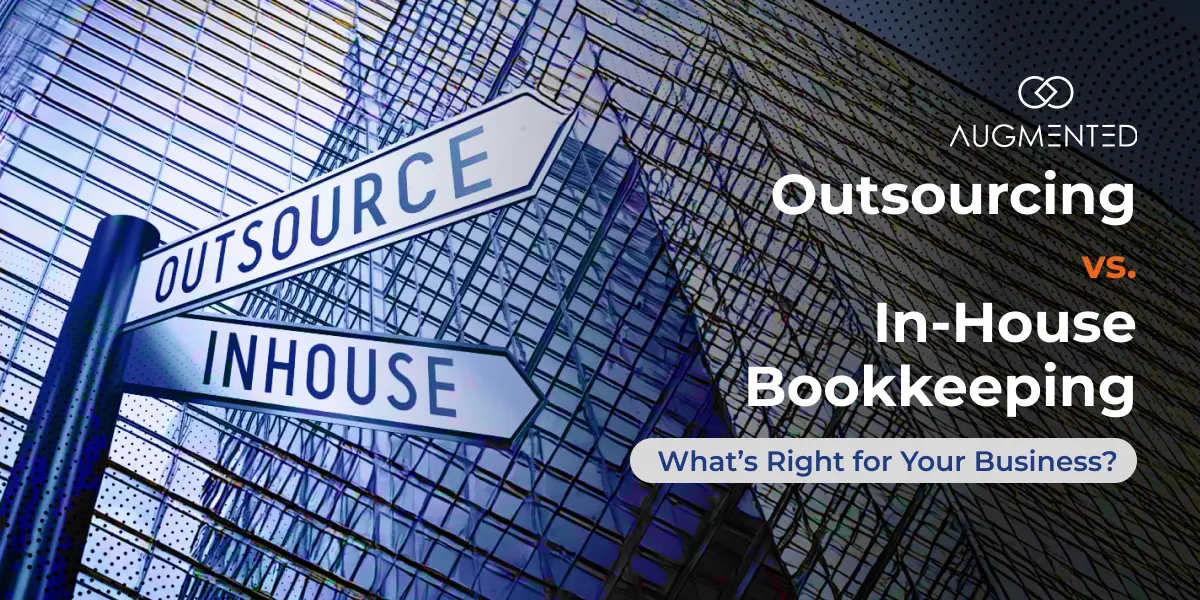
Outsourcing vs. In-House Bookkeeping: What is Right for Your Business?

Bookkeeping. Tax Codes. Financial headaches.

Fluctuating inflation, a labor shortage, and ever-changing tax laws are enough to induce a business panic, aren’t they?

Now, amidst this chaos of running a business, simplifying your finances is crucial. So, either you dive into numbers and juggle, or hand the reins to the experts and grow. 

Not sure what to do? 

What’s best for your Australian business? Consider the pros and cons and learn which is best: in-house or outsourced bookkeeping services in Australia.

Let’s start.

What is In-House Bookkeeping? 

In-house bookkeeping is handling the accounting and finances of a business internally. Your in-house accountants handle all the financial operations for your business.

Let’s say you are a small business owner, trying to focus on your business growth and satisfying your customers. With just one in-house bookkeeper, you manage all the financial tasks internally. The bookkeeper is:

  • Tracking transactions
  • Managing accounts payable and receivable
  • Payroll accounting for businesses
  • Preparing and filing tax returns
  • Bookkeeping, 
  • Budgeting,
  • Forecasting ( and so much more.)

But is one single bookkeeper capable of taking care of all these responsibilities? Maybe not. Of course, you might prefer having the numbers to yourself, but isn’t it challenging? Yes, you are the captain of your financial ship, but at what cost?

Is hands-on control and easily available data worth the business mess? Curious to know more? Below are the benefits and drawbacks of in-house bookkeeping. 

In-House Bookkeeping: The Advantages

Every dollar counts when running a business. And bookkeepers ensure that every dime you earn or spend is accounted for. In-house bookkeeping offers a significant advantage when it comes to controlling, customizing, and securing your finances.

Your in-house team is always on the ball, providing you with immediate access to financial data and ensuring the highest level of data security, giving you peace of mind.

  • Do you have a question about financial transactions?
  • Need a quick financial report?
  • Have a unique financial idea?
  • Want all your data to stay within your four walls?

Your well-versed in-house bookkeeper is dedicated to understanding and meeting your specific needs and preferences, providing a personalized and adaptable service.

But what about the high costs regarding salaries or potential training expenses? What about the time you spend diving into numbers instead of focusing on your customers? What if you miss the latest changed tax law due to workload in other business areas?

Chaos! A Business Panic.

In-House Bookkeeping: The Disadvantages

Imagine giving your customer a rain check. Why? Because you were busy with time-consuming bookkeeping tasks, such as reporting and data entry.

Of course, it is crucial to stay on top of your company’s financial health, but putting off a customer will not yield dollars for your finances. However, 64% of owners manage their books! 

No wonder spreadsheets, debits, and credits seem straightforward. But then the question is, what keeps bookkeepers up all night? What about the messy back office, missing numbers, and missed customer meetings?

  • Financial burdens
  • Sky-high salaries
  • A constant fear of errors
  • Compliance headaches
  • Limited expertise
  • Ever-changing tax rules
  • Technological troubles
  • Distractions from core business goals
  • Hefty penalties on missed deadlines 

Are you ready to tackle all these challenges of in-house bookkeeping? Or would you rather focus on what you do best and let the experts handle your finances?

What is Outsourcing Financial Services?

Outsourcing financial services is the process of hiring a third party to handle various bookkeeping or accounting tasks. This helps you save valuable time to focus on other aspects of your business. 

Outsourced accounting firms handle diverse aspects of your business finances. The outsourced firm maintains ledgers, files taxes, and helps you plan your finances (apart from many other tasks.) 

But why would a business need outsourced accounting and bookkeeping services? 

Let’s say your business is growing with an international customer base. You start facing complex financial challenges and juggling between diverse tasks.

  • You have various income streams.
  • You are also deciphering international tax codes.
  • Staying on top of ever-changing accounting rules.
  • Managing customers. ( And several other tasks)

Even your most skilled in-house team is now overwhelmed. What do you do? You either hire an accounting consultant or look for outsourced bookkeeping services in Australia.

So, do you want to have confidence in your numbers and come out of messy cash flows? Let’s look at the pros and cons of outsourced accounting and bookkeeping services.

Outsourcing Financial Services: The Advantages

Yes, outsourcing accounting work in Australia has risks. But, then, why are businesses considering outsourcing from the very beginning? Why is accounting a leading job being outsourced by Australian startups? (A survey from 57% respondents)

The answer is simple. As businesses grow, their financial landscape transforms. As businesses scale up in size, revenue and finances become increasingly difficult to manage. 

Outsourced accounting firms help eliminate these challenges.

  • Saves Costs

Outsourcing your bookkeeping can save you money. It eliminates the need for hiring, training, and retaining employees.

  • Boosts Expertise

Outsourced accounting firms give you access to skilled professionals with expertise, knowledge, and experience. They have the latest accounting standards and tax law updates.

  • Scalable

Another advantage of outsourcing is business scalability. With outsourced accounting and bookkeeping services, you can scale up and down according to your business needs.

  • Focuses on Core Activities

Outsourcing gives you the time to manage core business activities. You won’t have to juggle multiple roles. Alleviate your burden of bookkeeping and concentrate on strategic growth and your customers.

  • Improved Accuracy

You can get precise financial data in real-time with outsourcing. Using tools, accounting software, and technological advancements makes money management simpler. 

Cloud-based platforms offer robust security and improved accuracy for your financial information, with professionals ensuring a reduced risk of errors.

  • Compliance and Risk Management

Outsourced bookkeeping services in Australia comply with Australian accounting standards and tax laws. The firms follow all compliance requirements and adhere to the guidelines of the Australian Taxation Office (ATO)

Outsourcing bookkeeping and accounting services offers a range of benefits, from improved accuracy to scalability and compliance. But every coin has two sides, and so does outsourcing.

Outsourcing Financial Services: The Disadvantages

As we stand on the brink of technological revolution, dramatic shifts and challenges in the financial sectors are going to ‘brain drain’ people. No one can stop these waves as experienced professionals retire and business models change. 

Moreover, by outsourcing your bookkeeping services, you may risk relinquishing control over your financial operations. Potential drawbacks include

  • Communication breakdowns, 
  • Delayed responses and 
  • Reduced flexibility. 

Additionally, overreliance on external providers and concerns about data security can further complicate your decision-making process.

But no matter what you opt for, accounting and bookkeeping services depend on carefully evaluating your business needs. It depends on your business size, financial resources and how scalable you want your business to be.

The Difference: In-House vs. Outsourcing

But, again, the question is, what is best for your business? 

So, let’s get right to the point. Below are the key differences between in-house bookkeeping and outsourced bookkeeping services in Australia.

Dig in.

Factor

In-House Bookkeeping 

Outsourced Bookkeeping 

Cost

Higher costs due to salaries and training.

Full-time salaries are often replaced by service fees. Hence, lower costs.

Control

Direct control over the entire finances.

Less control, as service providers manage your finances.

Scalability

Limited scalability.

Highly scalable with growing business needs.

Flexibility

Financial processes can be tailored to your business needs.

Less flexible. Often follows standardized processes.

Expertise

Limited to the skills of in-house team members.

Wide access to expertise, knowledge and skills.

Data Security

You have control over data security measures.

Reliant on the provider’s data security protocols.

Compliance

Regular and ongoing training to stay current on the latest regulations and tax laws.

Familiar with the latest rules and regulations.

Technology

You need to invest in the latest technology and management.

Most providers use the latest and most advanced technology and tools.

Focus

It may divert your focus from core activities.

You have more free time to focus on other business tasks. 

Responsiveness

Immediate access to your financial data. 

May experience potential delays.

Bookkeeping is not for everyone. So first, evaluate what’s right for you and your business. Enlist your priorities, and based on your business and available resources, choose the one that perfectly fits your business needs. 

Pro tip: If you are still unsure, feel free to contact accounting consultants or outsourced accounting firms, such as Augmented Systems.

Make the Right Choice for Your Business

You have a business to run. Invoices, customers, planning, strategies, employees—everything is stacking up. On top of all this, a single thought of paying taxes is enough to make you sweat. 

The good news? You have a choice—between in—house bookkeeping and outsourcing. But before you make the choice, you need to consider factors like:

  • The size and complexity of your business
  • Your budget and resources
  • Frequency of your transactions
  • Your growth plans, and 
  • Your desire to scale your business

Ask yourself what you expect in terms of your finances. Do you want lightning-fast financials? Or do you prioritize cost-efficiency and the ability to scale with an outsourced firm? Not sure? Below are some numbers for you.

Numbers for Your Numbers

You may be ready to handle seasonal spikes and rapid growth, making flexibility a top concern. Or is tight cash flow forcing you to make tough business decisions? 

No matter where finances are taking you, making the right decision is important.

So, let’s delve into some numbers to equip you with the confidence to make the best choice.

  • Global cloud accounting software is booming. The market, valued at $4.78 billion in 2023, is not set to hit $7.33 billion by 2030. It is growing at a steady 6.2% annually.
  • Tough time keeping up with the new rules. More than 50% of firms say that keeping up with the changing rules is their biggest challenge in accounting.
  • Not future-ready. According to a study by AICPA (American Institute of Certified Public Accountants), 92% of CPAs are not ready for the future. 
  • Increased Revenue. The market size of accounting services in Australia (2024-2029) has grown at a CAGR of 2.1% over the past 5 years. It is estimated to reach $33.0 billion in 2024.

Over the past decade, Accounting in Australia has grown rapidly. While bookkeeping is important, most businesses focus on running other core business operations.

So, no matter how you handle your books, find a system that works best for your business. The key is to keep your business thriving.

Conclusion

Have you found the solution to your bookkeeping challenge? Stop spending hours on tasks that can be automated. Put your energy into driving business decisions, gaining financial insights, and meeting business goals.

Need help? Let our professionals handle it for you. More than 200 clients have faith in us with their accounting needs, and you can, too. Stop thinking and start acting. Talk to our experts today.

Categories
Accounting Services Blog

Role of Technology in Modern Accounting Consulting

Are your on-premise accounting solutions clunky? Are your accounting consultants struggling to keep up with the growing business demands?

The world of accounting is indeed shifting super fast. Automated processes are replacing repeated manual tasks of accounting (apart from many other benefits.)

But the question is how to adapt these advanced technologies without making this transitional change a struggle.

Dig into the blog to see how technology can make accounting a value-added strategy for your business rather than just being a ‘process.’

What is Modern-Day Accounting? How is it Different from Conventional Accounting?

Modern accounting is a combination of conventional accounting systems and new-age technologies. Modern accounting solutions use technology and software to automate processes, reducing the need for manual execution.

While traditionally ‘slow’ and  ‘hesitant’ to embrace new technologies, business accounting services are now on the cusp of a transformative era, ready to harness the potential of these innovations.  

For Example:

Businesses still relying on manual notes and spreadsheet-based accounting solutions for expense management will:

  • Collect receipts and separate them 
  • Manually enters the expenses into spreadsheets with details of vendors, date, amount and more.
  • Finally, reconcile them with bank statements and other financial statements. 

This traditional method of accounting when replaced with modern-day accounting software looks something like this:

  • Automated collection of receipts with smart or app-based technology
  • Extraction and categorization of expenses automatically
  • Real-time expense tracking and faster reimbursements
  • Elimination of reconciliation with integrated modern accounting solutions

This paper-based system when altered with modern accounting brings more efficiency, accuracy and transparency. But is this all? Is this the only transformation technology brings to business accounting services? 

Of course not. There is so much more. 

How is Modern-Day Accounting Different from Conventional Accounting?

Traditional accounting involves sorting infinite accounting files and manually recording expenses in ledgers. Today’s technology digitizes bookkeeping and automates tiresome accounting chores.

These changes have impacted various aspects of accounting. Let’s have a look at a few differences in the table below:

Factor

Conventional Accounting

Modern-Day Accounting

Data Entry and Storage

Manual bookkeeping and paper files

Automated data entry and cloud-based storage

Accessibility

Limited to physical accessibility

Accessible anytime and anywhere

Accuracy

Risks of human errors

Reduced errors with automation

Speed

Time-consuming 

Fast processing

Costs

High operational costs, such as paper, storage, labor

Lower costs with automation and digitization

Scalability

Limited scalability

Scalable with cloud solutions

Security and Regulatory Compliance

Locks, cabinets, and safes with manual compliance checks

Digital security measures, like encryption and access control. Automated compliance monitoring and reporting

Data Analysis

Basic analysis of finances

Advanced data analytics with AI and Big data

Customer Interactions

Face-to-face or on the phone

Digital Interactions

Adaptation

Longer learning curve because of manual processes

Ongoing curve with evolving technologies

The benefits of technology in accounting are changing the landscape. Modern accounting solutions are replacing conventional paper ledgers and books, and accounting consultants are no longer spending endless hours wearing green eyeshades. 

But what are these technologies that are converting the once-so-called boring profession into a dynamic and fast-paced success model? 

10 Technologies Disrupting Modern-Day Accounting

Gone are the days of heavy ledger books and calculators. Modern accounting solutions no longer keep accounting consultants or chartered accountants up at night. 

Modern-day accounting has effectively mitigated the risks of non-compliance with tax laws and procedural errors, making them the ‘nightmares of the past.’

How? Below are the top 10 technologies altering modern accounting.

1. Artificial Intelligence (AI)

AI tools can be custom-trained with financial data to streamline financing. AI mimics human intelligence to make financial decisions and enhance the accounting process. 

AI in accounting is helping businesses make better financial decisions. Did you know? AI in marketing is estimated to reach $4.791 billion in 2024, expanding at a CAGR of 48.4%. The benefits of AI-powered tools in accounting are many.

  • Reduces time and effort by automating data entry and processing tasks
  • Identifies anomalies by detecting fraudulent activities
  • Enhances the abilities of accounting consultants to provide actionable insights
  • AI analysis of customer data to offer tailored recommendations

Thus get a better edge over your competitors by harnessing the power of AI in your accounting firm. 

2. Machine Learning (ML)

ML is a part of AI that uses statistics and data to predict trends and patterns. It utilizes algorithms to analyze big datasets, a job that would take humans ages. 

You can swiftly process millions of financial invoices and transactions in real time with machine learning. This lets you make more accurate financial reporting.

Moreover, machine learning algorithms continuously learn and improve with time. Continuous learning helps ML algorithms detect fraud in financial statements.

ML can also help you analyze historical financial data, providing accurate financial forecasts. Moreover, it can identify potential risks for your business.

3. Automation

Accounting automation is software that allows businesses to automate their accounting tasks using automation. Therefore, helping accountants, bookkeepers, auditors and businesses:

  • Save time
  • Reduce cost
  • Eliminate human errors
  • Increase productivity
  • Foster collaboration
  • Enhance efficiency

Automation is transforming accounting, modernizing and minimizing human intervention and helping firms execute tasks flawlessly. 

4. Big Data

Big data indicates the massive data collected by businesses from various locations and sources. Big data plays a huge role in financial information and data processing.

  • It can analyze transactions
  • Detect anomalies
  • Foster deeper connections between customers, employees and vendors
  • Predict future financial implications
  • Provide valuable insights and recommendations

Today big data is the new power tool for accounting. It analyzes massive datasets to predict trends, spot risks and make strategic business decisions.

5. Robotics Process Automation

RPA is a type of business process automation that uses software robots and AI to imitate human actions. Robotic accounting is a type of RPA that uses robotic software to reduce human labor.

With the advent of RPA, the customer support landscape is significantly changing. Customers now interact with chatbots, consult FAQs, and provide feedback through RPA. 

This technology is revolutionizing how financial firms and businesses manage everyday tasks such as invoice processing and data entry.

6. Data Analytics

Data analytics helps process raw data to find trends and gain insights. It’s like traveling to the future to access valuable financial insights for your business. (It may not be as accurate as going to the future, but it is the next best thing for accounting.)

You can harness the power of analytics to:

  • Improve investment decisions
  • Optimize cash flow
  • Identify cost savings opportunities
  • Develop strategic growth plans

Thus with data analytics, accountants can identify patterns, monitor financial health and make future predictions. 

7. Data Security

Invest more to save more. Did you know organizations save approximately $1.76 million when using security AI and automation compared to organizations that don’t?

Businesses are investing in encryption, backup recovery and similar data security solutions to protect their data from hacking, data theft, phishing, and other threats.

A proactive approach to cybersecurity is ‘security by design.’ It means that the software products have already been designed to be fundamentally secure.

8. Block Chain

Blockchain is a type of digital ledger that stores data in blocks that are connected to each other. Cryptocurrency, Bitcoin is a type of blockchain that ensures transparency, integrity, and accuracy of transactions.

It is a tamper-proof ledger that offers,

  • Decreased fraud risks
  • Reduced business costs
  • Automation of routine tasks
  • Streamlines auditing process and more

Blockchain is becoming an increasingly emerging technology. In fact, the market size for blockchain technology is predicted to reach $868 million by 2025.

9. Low Code/ No-Code

No Code is an application or software development approach that does not require traditional coding or knowledge of programming languages. It is rapidly evolving to streamline financial tasks in accounting. 

It empowers accounting teams and professionals to automate tasks such as:

  • Accounts reconciliations
  • Journal entries
  • Financial statements and more

These no-code apps help teams process financial transactions seamlessly and efficiently when compared to conventional accounting.

10. Cloud-Based Accounting

Cloud-based accounting uses software in the cloud to perform basic accounting processes, such as managing books.

It helps businesses store financial information in a centralized location providing advantages such as:

  • Flexible access to accounting information
  • Real-time collaboration
  • Scalability
  • Cost efficiency
  • Eliminates device-specific constraints
  • Saves time
  • Enhances accessibility and security

This shift is replacing spreadsheets with dynamic cloud systems, thus improving business functionalities. 

Paper ledgers, journals and spreadsheets have swiftly changed to automation and AI. These technological changes are no more ‘future trends’ but ‘current realities.’ So, leverage these tools and software to scale your business to new heights.

How to Implement Technology in Your Accounting Practice?

Accountants sitting through piles of paper documents to crunch numbers is indeed a talk of the past.

Just being good with numbers is no longer enough.

Businesses and firms now want tech-savvy accounting consultants who keep pace with changing trends. In fact, more than 70% of business owners consider switching to an accountant proficient with modern accounting solutions. 

Implementing these technologies is far more interesting than just reading about them. Here’s how you can implement technology in your current accounting practice.

Step 1: Selecting the appropriate tool or software can be challenging. So, thoroughly assess your current accounting infrastructure. 

Step 2: Don’t follow the technological accounting bandwagon blindly. Set realistic and clear goals.  

Step 3: Research, learn and research again. Understand the emerging technologies in accounting. 

Step 4: Choosing the wrong software for modern-day accounting is way worse than not choosing any. Select the right software for your finances.

Step 5: Provide hands-on training to your team. 

Step 6: Take data security seriously. The digital era is all about data breaches, malware, and cyberattacks.

Step 7: Implementing modern-day accounting software needs planning, execution and data migration. 

But if you are still unsure about implementing these new technologies in your business accounting then outsource because every business is unique. 

Outsourcing: A Great Modern-Day Choice for Small and Mid Accounting Firms

Managing finances becomes an added responsibility when running a small or mid-sized accounting firm. Maintaining tax-filing deadlines and regulations and managing clients can be a headache.

These pressures can lead to burnout and poor services. Accounting outsourcing can be a turning point for many small and mid-size accounting firms.

The benefits of outsourcing accounting services are many, including

  • Professional and experienced accountants, 
  • Cost savings, and 
  • Improved customer satisfaction

So stop feeling overwhelmed with work and find the right accounting partner. 

Conclusion

It’s 2024 and there is no stopping in advancements of technologies. To stay connected with the world, enhance business operations, and stay ahead of the competition, modern-day accounting cannot be neglected.

So, if you want to upgrade your business accounting services, Augmented Systems has a team of certified accounting consultants available. Want to know more? Get in touch today.

Categories
Accounting Services Blog

The Role of Technology in Modernizing Accounts Payable and Receivable Functions

Is managing finances becoming a vicious cycle for your business? 

Handling invoices, tackling late payments, and struggling with limited visibility into your cash flow is a never-ending process. It is how most businesses are supposed to manage their money. 

But in a world where words like ‘Digital’ and ‘Modern’ are thrown around like confetti, what does a truly modernized accounting department look like? Is it just about being paperless, or is there more to it?

Curious about the future of finance? Dig into this blog to see how technology is shaping the industry. 

What do Accounts Payable and Receivable Mean?

Accounts payable and accounts receivable are essential elements of a financial balance sheet. No matter if its a business or corporate finance, AR and AP play a crucial role. 

However, AR and AP are often mistaken because they impact the inflow and outflow of funds within a business or company equally.

Account Payable (AP): The capital a company owes to third parties. It is considered a current or short-term liability and must be paid within a year. 

Example for Account Payable:

Say a supplier sends you an official purchase order, terms and conditions and sets a delivery date. 

The supplier agrees to cover some upfront costs and the remaining amount after the services are provided. (For example, 30% upfront and 70% upon completion, payable as debit and credit.)

Once satisfied with the service or product, the supplier sends you an invoice with the agreed-upon payment period. Until then, the pending payments remain as accounts payable. 

Account Receivable (AR): The money a company owes from its customers. Businesses usually offer a grace period to the customers to pay for the purchase. For example, ‘net 15’ means the customer has 15 days to make the settlement. 

Example for Account Receivable:

Say you provide a service or deliver products to your customers worth a specific amount. 

You provide your service on credit as the customer does not make instant payments. This credit is recorded as an account receivable, indicating how much your customer owes you for your goods or services.

Let’s understand the differences better:

Factors

Account Payable

Account Receivable

Definition

The amount of money you owe as a company to third parties. The third parties can be your suppliers, creditors, banks or other companies. 

Customers lend you services or products on credit and owe you money. 

Type

It is a current liability account, and the repayment terms typically depend on business to business.

Account receivable is considered a current asset in your company’s ledger.

Duration

The repayment periods could be as short as the next day, within a week or months. 

Depends on business to business.

Formula

(Starting + Ending Payable)/ two

[Starting + Ending Receivable (over a set period)] / two

Reason

To purchase items, services or products on credit

To sell goods and services on credit

Impact on Cash Flow

It is a liability (Cash outflow)

It’s an asset (Cash inflow)

Working Capital Impact

Decreases working capital after the payments are made

Increases working capital after the payments are received

Financial health for any corporate or business is determined by accounts payable and receivable. Managing finances is getting more and more time-consuming for many due to an increase in clients and data. 

Moreover, businesses and companies are leveraging bookkeeping software for small businesses to manage their liabilities and assets. Thus, the traditional paper-laden approach is now changing to modern accounting. 

Do you also want to ditch the old-school methods and work for a smarter future with accounts payable and receivable? Then, read ahead.

The Rise of Modern Technology

Why are almost 82% of businesses failing because of cash flow? Why are most of the startups toasting within a few years? Late invoicing, missed payments, and unrecorded transactions are killing businesses. Slow and error-prone manual accounting systems lead to cash flow chaos. But this is not all. Businesses face many other challenges every day with manual methods. 

Let’s have a look. 

The Challenges of Relying on Manual Methods of Accounting

Many businesses rely on manual efforts to manage accounts payable and receivable. This leads to obvious disruptions such as below:

  1. Time-consuming
  2. Prone to human error
  3. Leads to missed payments
  4. Delays collections
  5. Paper-based invoicing 
  6. Provides limited visibility
  7. Has missed communications
  8. Hinder decision making
  9. Lacks standardized workflows
  10. Inaccurately reports finances ( and many more.)

At the end of the 20th century, basic computers streamlined accounting and bookkeeping processes, making financial transaction tracking and management easier with accounting software and ERP (Enterprise resource planning) systems. 

But was that enough to streamline finances? No! Here’s why companies started switching to modern accounting solutions. Below are four benefits that can help you stay ahead with the digital trends. 

4 Benefits of Modern Technology in Accounts Payable and Receivable

Businesses are using platforms like Zoho, FreshBooks, and many others to handle their financial flow. Besides that, bookkeeping software for small businesses is also growing rapidly.

Moreover, businesses are switching to modern solutions like digital payments, electronic reporting and advanced technology such as AI (artificial intelligence). 

The impact of technology on accounts payable and receivable is above and beyond. Let’s see how.

1. Automation

Automation is taking over the world of finances, and enterprises are no longer relying on laborious, manual procedures to complete regular accounting chores. Additionally, the global accounts receivable market is predicted to grow by $1.13 billion by 2026.

With automation, you can:

  • Automate processes, such as invoice generation, payment tracking and reconciliation
  • Help businesses generate and distribute invoices
  • Send payment reminders
  • Get follow-ups on overdue payments
  • Free up your valuable time
  • Improved cash flow management 
  • Reduced costs
  • Secure and error-free payment systems
  • Focus on more strategic tasks 

The technological revolution has replaced the manual work of check payment methods and cash. You can now make instant payments by shifting to automation and electronic payment methods.

2. Integration

Digital technology is a game changer for traditional accounting processes. Businesses are integrating with other financial systems to improve their data accuracy and efficiency. 

  • Integrate with systems like ERP to get real-time visibility into your financial data. 
  • Manage customer relationships better with software like CRM (customer relationship management)
  • Make informed decisions
  • Foster strong relationships with suppliers and customers
  • Respond to market changes faster 

Moreover, integrating mobile technologies and the cloud is crucial in managing finances. Mobile capabilities allow users to access financial information like invoices and payments. 

3. Data Analytics

Data analytics enables businesses to analyze their raw data and convert it into meaningful insights. Through data analytics and reporting, businesses can make informed, data-driven decisions.

  • Uncover trends and patterns of your financial data with data analytics 
  • Develop targeted strategies and anticipate cash flow
  • Get insights into customer payment patterns
  • Identify bottlenecks in payment processing
  • Optimize credit management strategies 
  • Track key performance indicators (KPIs)
  • Address payment issues
  • Strengthen relationships with customers 
  • Offer tailored payment terms and solutions

With data analytics and reporting, you can streamline your communications and collaborations with your vendors and customers. Moreover, you can better understand customer behavior.

4. Customer Experience

With technological advancements, you no longer need paper invoices and phone calls. Technological changes have made the payroll accounting system a breeze.

  • Hold time and paperwork are reduced, making businesses happy
  • Convenient and secure payment services are a big benefit to customers
  • Decreased manual intervention
  • Automated reminders and notifications keep customers informed
  • Updates on upcoming dues and late payments
  • Instant support with chatbots and virtual assistance

Technology helps businesses build stronger customer relationships and enhances customer satisfaction and experience. 

By proactively tracking accounts payable, you can determine where your money is going and how to be more efficient. Moreover, you can stay current on your business’s profitability by monitoring accounts receivable. 

3 Ways to Modernize Your Finances

New technologies are reshaping the financial landscape worldwide. Financial processes are unprecedented opportunities for organizations to enhance their overall efficiency, accuracy and transparency in their operations. 

Read on to see how you can change your capital structure.

1. Artificial Intelligence and Machine Learning

AI and ML are helping develop powerful software that is capable of analyzing, interpreting and comprehending complex data. 

AI mimics human cognition to perform complex tasks and learn from them. At the same time, ML is a subcategory of AI that uses algorithms to produce adaptable models that can perform complex tasks.

  • AI and machine learning algorithms can help you get real-time financial insights.
  • AI and ML can help you revolutionize financial analysis, forecasting and risk management.
  • Automate tasks like invoice processing, fraud detection and data entry
  • You can make smarter decisions by analyzing historical data and predicting payment behavior
  • Suggest optimal payment schedules and collection strategies using AI and ML

Leverage the power of AI and ML algorithms to effortlessly detect irregular patterns in your financial system.

2. Robotic Process Automation (RPA)

RPA is an advanced business process automation that uses intelligent solutions to streamline repetitive tasks, reduce errors and optimize workflows.

  • RPA allows you to automate operations like sending invoices, tracking overdue payments and receiving clearance follow-ups. 
  • It improves cash flow by speeding up invoice processing and payment cycles.
  • Reduces manual work and helps focus on other tasks.

Robotic process automation is useful for many finance-related tasks, including accounts payable, accounts receivable and order processing. 

3. Blockchain

Blockchain is a distributed ledger technology that facilitates the use of digital bookkeeping and recording systems to capture financial transactions and related data. It can record transactions in multiple places at once.

  • It helps make transactions securely and transparently.
  • Get a tamper-proof record of your transactions and reduce the risks of errors and fraud.
  • Speed up your settlements using blockchain.
  • Create a transparent and efficient supply chain.

Blockchain technology can transform your payment processing system, supply chain management, and digital identity. It can also help businesses improve vendor and supplier relationships.

Modern technologies can help you create an efficient, secure, automated accounts payable and receivable system.

To help business owners not cringe at hearing the word ‘cash flow,’ here are a few tips to manage AR and AP.

5 Tips to Handle Accounts Receivable and Accounts Payable

Managing hundreds of different transactions can be a headache. Keeping track of what you owe, what you have sold and what your customers owe you can be difficult. 

However, cash flow management must be a top priority for all businesses and organizations. Here are five tips to assist you in reaching your financial goals.

Tip 1: Create credit policies. You can give greater payment flexibility to good credit customers and less leeway to new customers. Also, pay your suppliers when you receive items in good condition. This can help you take advantage of discounts.

Tip 2: Foster Communications. When dealing with large transactions, you might struggle to stay on top of both departments. Accounts payable and receivable can make you juggle. Communication between departments can make this easier.

Tip 3: Short Transaction Cycles. Establish shorter timelines for accounts receivable and payable. Shorter receivables can help you quickly deal with your accounts payable. 

Tip 4: Use Modern Technology: Tracking a missing invoice can be painstaking. Tracking invoices, receipts, order purchases, and shipping is too much work. Hence, use automation and modern technologies to track your finances. 

Tip 5: Ageing Accounts: Keep track of all your accounts and transactions. For all aging accounts, take action immediately. Establish timelines for when payables and receivables should be cleared.

You can automate these processes using accounts payable software or accounts receivable management tools. You can track anomalies and mis-interrupted workflows and determine your business’s financial health. 

Predicting the Future

People used abacus to keep track of calculations and machines that could help solve math problems. Accounting technology evolved to calculators, computers and now automation.

But what is the future of accounting? How will accounts payable and receivable functions change in the coming years? 

Imagine a future where the payment process is not just streamlined but fully automated. 

Conclusion

Technology and digitization have changed the global market in the last few years. They have influenced the nature of accounts payable and receivable functions, making them more than just the ‘bean counter’ of the past. 

The future of finances looks sorted and bright. If you are looking for modern financing methods, contact our experts at Augmented Systems.

Categories
Accounting Services Blog

Key Factors to Consider When Choosing an Outsourced Accounting Provider in Australia

Is accounting and managing taxes becoming a headache for you? Is the tax return deadline for this fiscal year in Australia making you nervous? Is in-house accounting making it costly?

Let’s face it: Accounting is a devil of a job. From accounting costs to tax return deadlines, nothing is easy. Consequently, many businesses are switching to outsourced accounting in Australia.

Are you willing to hire a company, too? If yes, consider choosing the right one from the pool of outsourcing companies competing for your business.

To do so, we have identified the top six factors to consider when choosing the right accounting services in Australia. 

Read ahead before you hire one. 

Why is Selecting the Correct Accounting Outsourcing Provider Important?

Accounting outsourcing frequently brings obstacles such as sloppy account management, errors, and compliance issues. 

Picking the right accounting services in Australia is a challenging but essential decision. Why? 

Let’s look at an example to better grasp this. 

BDC PVT. LTD. is a manufacturing business based in Melbourne. The company decides to outsource its accounting services to reduce costs, improve efficiency and focus on other business work. 

They opt for outsourced booking services in Australia. The company owner did not assess them or their expertise. Attracted by their low fees, the business owner did not also check for their lack of experience in Australian tax laws and regulations. 

As a result – the manufacturing business faced several consequences. A few of them include: 

  • Hefty fines by the Australian Taxation Office for non-compliance.
  • Negligence of data security measures led to cyberattacks. Thus compromising sensitive data and financial information.
  • Loss of trust from stakeholders and unforeseen expenses.

Hence, the right outsourced accounting firm in Australia can solve all your headaches overnight, but the wrong one could risk your reputation!

So, to make the right call, consider the following 6 main aspects when outsourcing accounting work in Australia.

6 Things You Should Consider When Selecting Outsourced Accounting in Australia

Businesses are considering Accounting Outsourcing in Australia from the very start. 57% of respondents to a survey conducted in 2023 said accounting was the leading job being outsourced by startups in Australia. 

However, outsourcing has risks. Therefore, we have compiled the following six aspects that should be evaluated before hiring for accounting services in Australia. 

Let’s dig in to know more. 

1. Accounting Specialties: Expertise, Knowledge and Experience

Hiring an accounting provider should be done with preciseness. The outsourcing accounting firm should have the expertise, knowledge and experience to manage your finances. 

Before hiring outsourced bookkeeping services in Australia, ensure they possess the following:

  • They should have appropriate qualifications and certifications, such as CPA or CA. The certifications will exhibit their level of expertise. 
  • Experience in your business’s industry should be next on the checklist. If a firm has experience unique to your sector, you can rest assured that the company has also mastered the rules, policies, and obstacles for you.
  • Technological knowledge is another crucial part. The outsourcing company needs to be proficient with accounting software and technology platforms. 

By weighing these factors, you can choose an accounting outsourcing provider that best suits your needs and your company’s objectives.

2. Take Cost-Effectiveness and Scalability into Account

Hiring an outsourced accounting or bookkeeping service in Australia does not mean you have to burn a hole in your pocket. You are outsourcing because you are penny-pinching (apart from several other reasons), correct?

Hence, an outsourcing accounting provider should help you save costs. On the flip side, also provides you with scalable solutions that grow with your business. 

The charges are generally competitive, so look for several options. Get quotes from different service providers, compare and then hire. 

3. Communication: Clear, Consistent and On-Time

A lack of communication can ruin your business. But how would you assess whether the communication is clear, consistent, and timely?

  • First, evaluate the firm’s responsiveness. Was the response during your initial conversations prompt and comprehensive?
  • Second, are you using communication channels, such as emails and video calls, preferred by you? 
  • Next, do you have a designated person for all your communications? If yes, is there transparency regarding every aspect of your business, including finances?
  • Are they alerting you about all the necessary deadlines, such as tax filing deadlines? 

These are some communicational points on which you can evaluate an outsourced accounting firm in Australia. 

4. Qualifications and Certifications

Another key factor to consider when outsourcing accounting services in Australia is checking the provider’s qualifications and certifications. 

Double-check that your accounting firm has certified accountants with the necessary qualifications and certifications. 

These compulsory certifications are:

  • A 4-year full-time degree: An accountant should have a bachelor’s Degree in Accounting, higher or equivalent. 
  • Should have professional recognition by the CPA: The Certified Practicing Accountant in Australia is considered one of the leading professional accounting bodies in Australia. It offers CPA certifications or designations. 
  • Professional Certification of a CA: The accountant or the accounting firm should have Chartered Accountant certifications. The certification indicates cutting-edge knowledge and skills in accounting and finance. 
  • Industry-Specific Certificates: These certificates depend on the sector or industry the outsourcing accounting firm is working for. They should have relevant certifications related to your precise sector. 

Therefore, before hiring a firm ensure that they have the expertise to do your accounting work. 

5. Technology: Innovative Infrastructure, Security and Privacy

In the accounting business, confidentiality, security, and privacy are essential. There before hiring, look for a firm that:

  • Uses advanced accounting software
  • Has safe and secure data storage 
  • Automation technologies with stringent security protocols
  • Strict confidentiality policies 

Moreover, your data could be at risk if the firm does not adhere to the strict security and privacy compliances of the (ATO) Australian Taxation Office

Therefore, find a firm that adheres to high-tech accounting infrastructure, secure data storage options, and ATO compliance.

6. Guidance and Support

Every corporation has its unique set of prerequisites for finance management. Finding an outsourced accounting firm that caters to your business needs is fundamental. 

Here’s what you can look for in terms of guidance and support from a firm you are willing to hire:

  • The accounting firm should advise you on compliance with the Australian Taxation Office (ATO). 
  • You can evaluate them based on their responsiveness towards your problems and questions. 
  • Consider how the firm provides guidance and support specific to your industry in the initial stages of communication. 
  • The firm should also guide you through GST, timely submission of tax returns, accurate reporting, and more.
  • Examine the firm’s training, staff support and educational knowledge. Get feedback from other businesses that might have hired them for similar services.

Furthermore, according to your tailored business needs, they should provide guidance and support as and when needed. 

Therefore, consider all of the factors above. Moreover, you can ask them questions before signing an agreement. Below are some questions you can ask. 

Top 10 Questions You Can Ask an Accounting Outsourcing Firm

Thoroughly investigating the accounting company you plan to outsource to in Australia is vital. Before entrusting an accounting service in Australia, ask the firm the following 10 questions. 

Question 1: What is the accounting outsourcing service provider’s niche? How much have they grown or have the experience in this field?

Question 2: How much will they charge you? How will they calculate your pricing or fees?

Question 3: What will be their delivery or response time for your project? Will they provide 24*7 access to your financial or accounting records?

Question 4: Do they have the required qualifications and expertise for your company? Do you have licenses and certifications?

Question 5: Is the service provider updated with the latest information for your business? Do they follow the latest encryption and security protocols?

Question 6: What information or data do they need from you throughout the year? Will their services be scalable? 

Question 7: Can the outsourced accounting firm represent you in the event of a tax audit?

Question 8: Who will be responsible for your accounts? Does the accountant know the latest technology? 

Question 9: What kind of communication will be implemented between you and the outsourced team? Will they have a direct communication with you?

Question 10: Will the team working for your company be assigned to other clients? If yes, what will be the privacy protocols and compliances? 

Apart from asking these questions, you should visit the company in person, get to know the individuals who interest you, and then determine whether or not to trust it completely.

Conclusion

Outsourcing accounting services in Australia can either make or break your business. Before hiring one:

  1. You can consider referrals, 
  2. Check customer reviews and testimonies or 
  3. Get consultations from our certified experts at Augmented Systems

We know keeping track of every dollar when running a business can be daunting. But we can help you solve all your problems. With our professionals, you can get hassle-free financial management services.

Categories
Accounting Services Blog

How Payroll Accounting Software Can Streamline Your Business Operations in Australia?

Are you also stuck in the web of Australian payroll regulations? Don’t worry you are not alone.

Most Australian businesses spend hours on manual calculations and worrying about changing taxes. Moreover, complying with Australian employment laws and regulations can be a headache.

This is when payroll accounting software comes in:

  • It keeps you on top of all the changing taxes and 
  • Takes you out of the breeding ground of errors and miscalculations.

Want to know how? Dig into this blog to learn why you need payroll accounting software for your Australian business.

What is Payroll Processing in Australia?

Payroll processing is the management of payrolls, which include taxes, benefits, and employee remunerations. An employer calculates and distributes its employees’ wages in an organized manner.

Thinking about payrolls may sound exciting at first. However, accounting services in Australia are unique yet complex. 

The Australian payroll system follows certain steps:

  1. The employer calculates the employee wages based on worked hours, overtime, and other allowances or bonuses. 
  2. Next, the income tax, superannuation contributions, and other legal payments are calculated. These are then deducted from the employee wages. 
  3. After all the calculations, the employer generates pay slips that include information on taxes, deductions, and gross earnings. 
  4. Finally, the employer submits the payroll reports to the Australian Taxation Office (ATO) via Single Touch Payroll (STP).

This entire procedure is important and must be done thoroughly. Any errors in employee payment or award classification can lead to severe consequences, such as business bankruptcy and criminal charges. 

What is Payroll Accounting Software?

Payroll software, or payroll systems, automates and streamlines necessary payroll procedures. Payroll accounting software can be on-premise or cloud-based software solution. 

Every payroll software is different from the others, but common features include:

  • Employee information
  • Defined payment periods and related payroll schedule
  • Information about taxes and other deductibles
  • Paycheck data for analysis
  • Payslip distribution to employees
  • Capabilities for Payroll compliance

The payroll accounting software can be modified based on how taxes are filed in each country. For instance, accounting payroll services in Australia require features like Single Touch Payroll (STP) reporting. 

Why Australians Should Consider Using Payroll Accounting Software?

Whether you are a business owner in Australia or some other country, payroll management is an important aspect when running a business. Accounting services in Australia, especially, are complex and subject to regulations. 

You would not want your business in jeopardy solely because of payment management oversights. Therefore, consider investing in payroll accounting software or Australian outsourced bookkeeping services.

Here is an example of how you might benefit from payroll accounting software or outsourcing accounting Payroll Services:

Imagine a situation where one of your employees works 35 hours weekly. The hourly rate for the employee is AU$23, and the overtime rate is 1.5 times the gross income. The employee works an additional 6 hours every week. Furthermore, the company has 100 such employees.

Scenario 1 (Manual)

Scenario 2 (Using Payroll Accounting Software)

The accountant or HR manually calculates the gross wage for each employee. 

The HR or accountant uses payroll accounting software.

This process is time-consuming and prone to errors – resulting in compliance issues with the ATO. 

The software automates and streamlines the process. Proper reporting to the ATO eliminates risks.

The employees may or may not receive their payslips on time. The wages could be inaccurate due to human errors.

The employees receive their payslips promptly and their wages are accurate. 

Consider the circumstances presented above and ask yourself why you should not invest in payroll accounting software. 

There are many benefits of outsourcing accounting services or investing in payroll software for your accountants. To learn more, explore the benefits below and streamline your business operations. 

6 Benefits of Using Payroll Accounting Software to Streamline Business Operations

There are several advantages to using payroll software for accountants to handle internal payroll processes. Among the prominent ones are:

1. Saves Time and Money

As discussed, accounting services in Australia can be rough. Managing finances often gets hard. 

Moreover, businesses find it difficult to manage their payrolls with complex accounting payroll services in Australia, including

  • Modern Awards,
  • National Employment Standards, 
  • The national minimum wage,
  • Superannuation obligations, and more.

Thus, payroll accounting software eliminates your manual payroll processing work. The software automates all the intricate calculations, processes, and tax deductions.

What used to take days can now be done within a few hours, significantly reducing the time on payroll tasks. 

Moreover, a poorly managed payroll service could result in penalties and reputational damage. The software works efficiently and accurately, saving you unnecessary monetary loss.

2. Provides Data Security

Every business owner, including you, wants your business and its operations to advance and be successful. However, with increased productivity, you are prone to hire more employees. 

As the number of employees increases, the amount of employee data doubles. Manual calculations and data entries are always prone to data loss or breaches. 

However, payroll accounting software comes with robust security features. These features help you protect your employees’ sensitive data and ensure compliance with Australia’s data protection payroll regulations. 

3. Prone to Fewer Mistakes

The 2023 Payroll Survey results show that around 55% of payroll professionals report increased workload since the epidemic. As payroll manual processing time grows, so does the possibility of inaccuracy. 

Payroll software guarantees that all employee earnings, taxes, deductions, and other expenses are correctly computed. 

Furthermore, payroll software can synchronize leave balances, overtime calculations, attendance tracking, and hourly extra hours. Leading to fewer mistakes and happy employees.

4. Employee Satisfaction

Several accounting payroll services include features such as self-service portals for employees. You simply have to give your employees access to the portal to use these. 

The portal allows your employees to access their pay information, tax records, and pay stubs. They can examine and manage their payroll details anytime and anywhere.

This not only benefits your HR team or accounting department but also gives the employees a sense of satisfaction. 

5. Automatic Calculations

Using a payroll system remarkably reduces the risk of probable errors made by human factors. The accounting payroll software gets automatically updated with the latest tax rules according to the ATO. 

The automated updates remove the chance of tax-related errors. It also ensures that the correct amount of income tax, social security contributions, and other deductions are taken out of employee paychecks.

6. Scalable for Expanding Businesses

If you are planning to expand your business, payroll accounting software can offer many benefits. 

Of course, there are many outsourced bookkeeping services in Australia, but global payroll operation comes with challenges with expanding business beyond borders.

Having a single platform for all accounting payroll services is always a good idea. Instead of managing cumbersome payroll-related operations from various locations, you as a business owner can focus on more intricate business processes with a single software.

In the End

Payroll accounting software can transform your organization’s financial management system. With the technological advancements, adapting to accounting payroll services has become necessary.

Investing in reliable payroll software will help you manage your payroll effortlessly, increase efficiency, and reduce workload. 

So, if you are looking for a hassle-free financial management service provider or any other accounting service needs in Australia, contact our experts at Augmented Systems.

Categories
Accounting Services Blog

Should Business Owners Consider Tax Preparation Services?

Do you ever feel like you are soaking in an ocean of taxes? And what do you think about those tax laws that often change? Juggling between millions of business tasks and taxes is a common struggle.

Moreover, with tax season approaching, it can be a headache for business owners.

This is when you can consider tax preparation services—a way to hand over your tax burden to professionals who eat and sleep taxes. 

Let’s discuss how this might be an ideal choice for your business.

Tax Preparation Service: What Is It?

Tax Preparation Service: Tax preparation services help businesses, associations, and individuals file and organize taxes.

Who provides these services? Accounting firms and tax specialists who live and breathe taxes. Accounting and taxation services firms ensure taxes are submitted correctly, quickly, and securely. 

For example, 

A business owner takes care of their business accounting services. However, as tax season approaches, the owner may not know: 

  • what taxes to submit, 
  • what form to fill out, or 
  • what deductions his business is eligible for.

This is when tax preparation services come in. A tax preparation service provider or an accounting consultant will help you with the following:

  • Collect your financial information
  • Review your files and records
  • Help you fill out the necessary tax forms
  • Ensure that your tax return is valid and compliant with the laws
  • Secure optimized tax returns so that you get minimal liabilities and maximum reimbursements

Hiring a professional for tax preparation services can bring many advantages to a business. Dig in to see how.

What Advantages Tax Preparation Services Offer?

Tax preparation services simplify complicated tasks of filing taxes for businesses and individuals. 

You can hire professionals with expert knowledge of tax laws and regulations. By leveraging professional assistance, you can save time, minimize errors and concentrate on your core business work.

Here are the top 7 advantages of tax preparation services. 

1. It Saves You Money

If you have not yet considered hiring a tax accountant because of its associated costs, think again. Contrary to what you would believe, it is not expensive.

  • Experts in taxation examine your accounting and bookkeeping files to look for deductions you possibly overlooked.
  • They also look for late or incorrect tax filings.
  • Accounting consultants also help understand tax ramifications.
  • Tax preparers also help file for IRS tax refunds

Therefore, hiring a tax preparation service is a wise choice. They inform you about your deductibles and guarantee accurate and penalty-free tax filing, giving you peace of mind. As a result, you eventually save money. 

2. It Is Time-Saving

As a business owner, filing taxes can be daunting as it takes up a lot of time. Efficient time management is crucial for the success of any business. And tax preparation services can help you save time. 

Taxation offices usually lodge tax returns within 12 business days. Twelve days is a long time, which can disrupt other business priorities. Moreover, consider the countless hours spent trying to understand the rules, forms, and other tedious paperwork. 

So, let the professionals handle your taxes while you save time and handle your business. 

3. Helps You With Tax Planning

Professionals who provide taxation and accounting services and have all the knowledge and expertise of taxes.

  • They suggest strategies and advice that can reduce your taxable income.
  • They can advise on investments that you can make for your business.
  • You can discuss strategies to manage your expenses throughout the year. 
  • Professionals also suggest ways to take advantage of tax credits and deductibles. 

Tax professionals strive to optimize your tax returns so that you get minimal liabilities and maximum refunds.

4. Gives You Peace of Mind

Tax preparation services provide businesses like yours with professionals and accounting consultants. The professionals provide reliable services, helping you ease the burden of managing taxes. 

A tax professional will assist you every step of the way – from gathering relevant income statements and expense records to tax return processing.

They will also provide you with tax guidance and insights that will help your firm expand. As a result, you can unwind, knowing that your taxes are in capable hands.

5. You Can Avoid Penalties

You are a business owner, not a tax pro! No business owner wants to transform their business burden into a nightmare. While filing your taxes, you may miss out on the most important and common details. 

  • providing incorrect account details, 
  • unreported income, or
  • filing too early or too late. 

These tax mistakes can lead to several penalties. Thankfully, when you use tax preparation services, you can rest assured that the professionals will follow proper rules and regulations. As a result, the chances of penalties are reduced or completely avoided. 

6. Focus on Core Business

With accountants and professionals by your side, you can focus on your core business. 

Tax preparation services have several benefits, including updating you with changing laws and saving you money. Moreover, you will not have to answer millions of questions if anything comes up from the IRS. 

The experts ensure that they file your taxes accurately and effortlessly. Eventually, you will be left with your business, where you can focus on other important tasks. 

7. Keep up With Any Changes to the Tax Laws

Tax Laws, rules, and regulations are always changing. It is typical for a business owner to be clueless about these changes.

Moreover, it depends on businesses and individuals if they wish to keep themselves updated with the latest laws. However, when it comes to professional account consultants, they have to keep up with the latest updates. 

As a result, they constantly update you with the frequently changing laws or tax codes.  

Therefore, tax preparation services can be a great aid, especially to business owners who are new to tax laws, have complex business situations, or are overwhelmed with work.

3 Tips Your Business Needs for Tax Preparation Services

Are you considering tax preparation services for your enterprise but are skeptical about where and how to start? Don’t worry. Below are three tips to help you get started. 

Tip 1: Keep Your Finances Organized

You are managing your business accounting services, i.e., managing your day-to-day finances. But now that you are considering investing in tax preparation services, you will work closely with professionals and experts.

So, to streamline your process and ensure a smooth transition, ensure the following:

  • Organize your records: Maintain and organize your transactions and payment receipts.
  • Keep separate accounts: Ensure you have different business and personal needs accounts. 
  • Try to stay informed: Before you connect with an expert, stay updated on changing and current tax laws. 
  • Avoid last-minute stress: You must plan before the tax season starts. Decide whether to consult an accountant, a firm or outsource. 

Tip 2: Accounting Outsourcing: Hire a Third Party

You have complete control over whether to use outsourcing accounting services or engage an accounting consultant, regardless of your company’s size.

Accounting outsourcing, however, can help small and midsize business owners save money. Businesses that require specialized accounting services ought to think about outsourcing as well. 

For example,

A small business with limited resources and finances might choose outsourcing for accounting and bookkeeping services. Outsourced accountancy services will help them save money. Also, the business will not have to train or hire in-house accountants.

Therefore, accounting outsourcing can be cost-effective and also align with your specific accounting needs.

Tip 3: Get Connected With an Accounting Company

Consider hiring an accounting consultant or company if you own a large business with intricate financial operations and huge budgets. These firms and experts have comprehensive knowledge and expertise.

For example,

A medium-sized company can hire an accounting company for comprehensive financial analysis, tax filing, and other tax support. 

Although it might require higher initial costs, you can benefit from personalized financial advice and strategic insights for long-term financial growth.

Conclusion

Tax preparation services are a must for any business. The tax experts will keep you out of trouble and allow you to focus on other business matters.

Moreover, Additionally, tax experts who understand accounting ensure that they follow the law and save you money. 

However, finding the right expert is as good as deciding to ask for help. 

So, get in touch with us at Augmented if you are looking for certified accountants who have the expertise to do your accounting work securely and swiftly.

Categories
Accounting Services Blog

Taking the Leap: Outsourcing Accounting Services in Australia for Maximum Efficiency

Finance plays a crucial role in every business, be it a startup or a multi-million dollar corporation. Nobody, especially entrepreneurs wants to face the nightmares of a financial crisis.

Over the past few decades, the role of accountants has grown. Especially in countries like Australia; where the accounting industry faces critical skill shortages and the ability to draw levels to the market trends.

This is where accounting outsourcing comes in!

Accounting and bookkeeping services help handle day-to-day business operations like employees – giving you and your business time to breathe and focus on what’s necessary.

So, let’s dive into this blog to learn more about the hows and whys of accounting outsourcing in Australia.

Why Businesses in Australia Should Outsource Their Accounting Services?

The two most crucial elements of running a successful business are – reducing costs and enhancing efficiency. For most large organizations, outsourcing helps them tick these two boxes.

1. Company’s Growth:

Accounting and bookkeeping services help businesses focus on what’s important. By working with accounting consultants and services, you can redefine your role and keep your business running smoothly. 

According to a report by Research And Markets, the global accounting services market is predicted to reach $735.94 billion in 2025 at a compound annual growth rate (CAGR) of 6%.

So, as a business owner, you can now focus more on your business and clients. Thus, outsourcing services will help you manage payables or receivables and maintain records.

2. Keeping Tabs on Accounting:

Keeping track of how well your business is doing is of utmost importance. You might not be available 24/7 and 365 days to check or create accurate financing reports. Of course, an in-house accounting team can help, but it can be expensive for a company.

This is when accounting and bookkeeping services professionally help you with your finances. They will regularly update you on your financial operations and help you analyze market trends.

Accounting Outsourcing for Australian businesses can be a game-changer. So, let’s discover the key benefits that help you save time and money while enhancing your financial management. 

Key Advantages of Outsourcing Accounting Services in Australia

The benefits of outsourcing accounting services or hiring an accounting consultant are endless. According to AFR, companies in Australia are paying 25-50% less per employee by outsourcing accounting services offshore. 

Here are the top five benefits of accounting outsourcing:

  1. Cost Efficiency

Outsourcing accounting services is highly cost-effective for businesses.

Save Time and Money: Skilled professionals help you save time and money. You can delegate them the repetitive tax return processing, bookkeeping, or verifying compliance documents and certificates.

Discretionary Expenses: When you hire a full-time employee for accounting, you will need to spend on salary, tax, office equipment, and more.

Fixed Rate and Hours: For an outsourced accounting company, you only need to pay for their accounting services or accounting consultations. Moreover, they often operate on an hourly rate or a fixed fee.

Overall, your business gets better control over your budget when accounting outsourcing in Australia. 

2. Focus on the Main Business

As discussed above, accounting outsourcing allows you and your business to concentrate on core activities and make strategic goal plans.  

The management team can direct their vision toward business development, customer service, client interactions, and overall operations. 

You can create a solid roadmap for your company’s financial growth when you let your employees do what they do best and outsource the rest.

3. Specialized Skillset and Expertise

Managing accounting processes can be a task. Even with the latest tools and technology at your disposal, you need an expert to run the accounting team and manage the clunky process.

You can easily navigate your accounting process with the right support and expert assistance. Moreover, your in-house accounting team can be expensive. 

So don’t let accounting become a burden – get the help you need to streamline your operations and achieve success. 

4. Flexibility and Scalability

Companies may scale up or experience a dip in business activities, especially if it’s a seasonal business or has fluctuating workloads.

If your company scales, every department grows, particularly accounting. Your payables and receivables reach numbers that you may have never handled before. By default, you will need to hire more employees.

On the other hand, if your company experiences a sudden plunge in your business activity, you might need to scale down your employees to manage finances.

To manage a company single-handedly can be overwhelming. Juggling between employees, finances, and company security requires much effort. 

If you outsource, a sudden scale-up or down won’t be an issue, as accounting outsourcing companies can manage the accounts depending on the current needs. 

5. Risk Management and Compliance

There is no denying the fact that fraud may occur. Your business and finances are always at risk. Even in-house accounting departments are not immune to internal fraud.

However, accounting outsourcing services can significantly reduce the risk of security breaches, data theft, and other fraudulent activities.

Accounting Regulations: Accounting outsourcing companies are well-versed in local and international accounting regulations. So, you can rest assured that your company is in safe hands when outsourcing.

Error Risks: The local and international accounting regulations help reduce the risk of errors or non-compliance penalties for businesses. 

Market Reputation: The outsourcing agencies will not do anything that would hamper its reputation in the market. 

Things to Consider Before Outsourcing

Every coin has two sides. While accounting outsourcing can offer several benefits, it’s always best to consider potential drawbacks. So before you dive in, consider these four points. 

1. Data Security and Privacy

Do not forget that you are sharing all of your and your client’s sensitive financial information, like bank account details, transactions, and more, with a third party.

Ensure that the accounting outsourcing company you hire meets all security standards and requirements. It would help if you kept a tab on data breaches, privacy and security, and the risk of unthaurized access.

Tip: Before hiring an accounting company, understand how their team will work on security compliance. You can ask them what measures they will take to prevent security breaches.

2. Quality

Quality over quantity. You are giving the most crucial part, i.e., handling your business’s finances, to a third party to handle. So, never compromise on the quality of accounting and bookkeeping services for your business. 

Of course, outsourcing companies provide experienced and professional experts. However, knowing their qualifications and experiences is never a loss. 

Tip: Choose an accounting outsourcing company that has hands-on experience with the services that your company needs. Do your research before you start working with one.

3. Communication

Communication is the key to any business. A two-way communication between you and the company you hired is pivotal. 

You may experience differences in time zones or language barriers, hindering the overall process. So, it’s always a good option to have clarity about everything and anything via communication. 

Tip: You can use well-trusted communication channels like emails or other third-party apps. Schedule regular meetings to keep track of work and receive updates on assigned tasks also helps create good communication.

4. Cost Transparency

While accounting outsourcing can be cost-effective, there can always be hidden costs. 

The hidden charges for providing accounting services may include additional fees for extra services or charges for hiring more accountants. These hidden charges might not be discussed or neglected when signing a contract. 

Tip: Always read the contract thoroughly before signing it. Remember not to skip pages and pay close attention to the hidden clauses. 

Conclusion

Accounting outsourcing services have now become a necessity in the ever-evolving business landscape. Companies providing Outsourced accounting services can be a game-changer in enhancing your financial management.

If you need one, we at Augmented Systems provide accounting outsourcing in Australia. You can find a trusted partner in us, as we provide quality work securely and efficiently.


Many Australian companies trust us with their accounting needs. So, be the ‘pathbreaker’ for your company and contact us for services, including payroll, bookkeeping, taxation, and much more.